
Empowering Civil Society to Shape DPI Governance in Latin America and the Caribbean
Momentum for Digital Public Infrastructure is rapidly growing in Latin America and the Caribbean. From the mighty cases of PIX and gov.br in Brazil to Bre-B, the new instant payment system in Colombia, Ciudadano Digital LAC, the cross-border digital identity system being piloted in Uruguay, Brazil, and Argentina, or Llave MX the Mexican digital identity system currently being deployed, there are plenty of examples of how these technologies are transforming the way governments engage with their citizens and residents and provide services to them. But alongside the benefits and opportunities that come with the development of these services, the risks of exclusion, misuse, data breaches, or fraud also grow.

At Co-Develop, we believe that a key way to address these risks is by ensuring that governance spaces for DPI systems are democratically organized and represent civil society organizations (CSOs) voices, – organizations that are closest to understanding public concerns and proposing solutions that address the grievances people face when DPIs are introduced. For this reason, we’re very excited to announce the institution of a consortium for LAC on DPI governance that brings together three highly accomplished organizations in the region with deep expertise in digital governance, open data, and open government: ILDA, Open Data Charter , and Cepei.
A project focused on CSOs
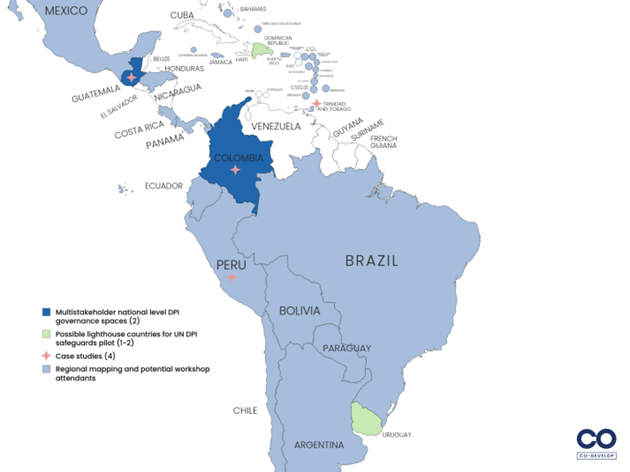
There’s particular strength in channeling this work through a self organized Consortium of CSOs, as it sets us up to cooperate rather than fragment the space. And the combined forces are welcome, as the consortium will address two big challenges at once: building the capacity of LAC CSOs working in DPI-adjacent fields, such as digital rights and open data, and creating multistakeholder institutional and participatory spaces for DPI governance. The capacity-building efforts will empower CSOs to meaningfully participate in and shape these spaces, build trust, and ensure DPI systems are safe and inclusive.
The project will focus on three core objectives:
Building the capacity of CSOs through specialized training on DPI across the region and establishing multistakeholder collaboration spaces for governance.
Developing new content, including case studies and learning materials, and translating existing guides into Spanish, a crucial need for this region.
Supporting the piloting of the UN DPI Safeguards in two countries in LAC.
Creating synergies and lasting impact
We expect this effort to be a force multiplier: CSOs that take part in the training will become regional disseminators, engaging effectively in their national contexts and achieving meaningful, sustainable impact. And they will not be alone: the consortium’s efforts are well integrated with Co-Develop’s broader capacity-building strategy and other regional investments aimed at advancing DPI.
By empowering civil society organizations, this project aims not only to strengthen governance but also to ensure that the benefits of DPI reach all citizens equitably. If you’re interested in taking part in the capacity building sessions we’re planning, or want to learn more about this effort don’t hesitate to reach out to us at aura@codevelop.fund or juan@codevelop.fund. Follow our journey as we work with partners across the region to build safe, inclusive, and effective digital public infrastructure.