Stories of Impact | Ethiopia
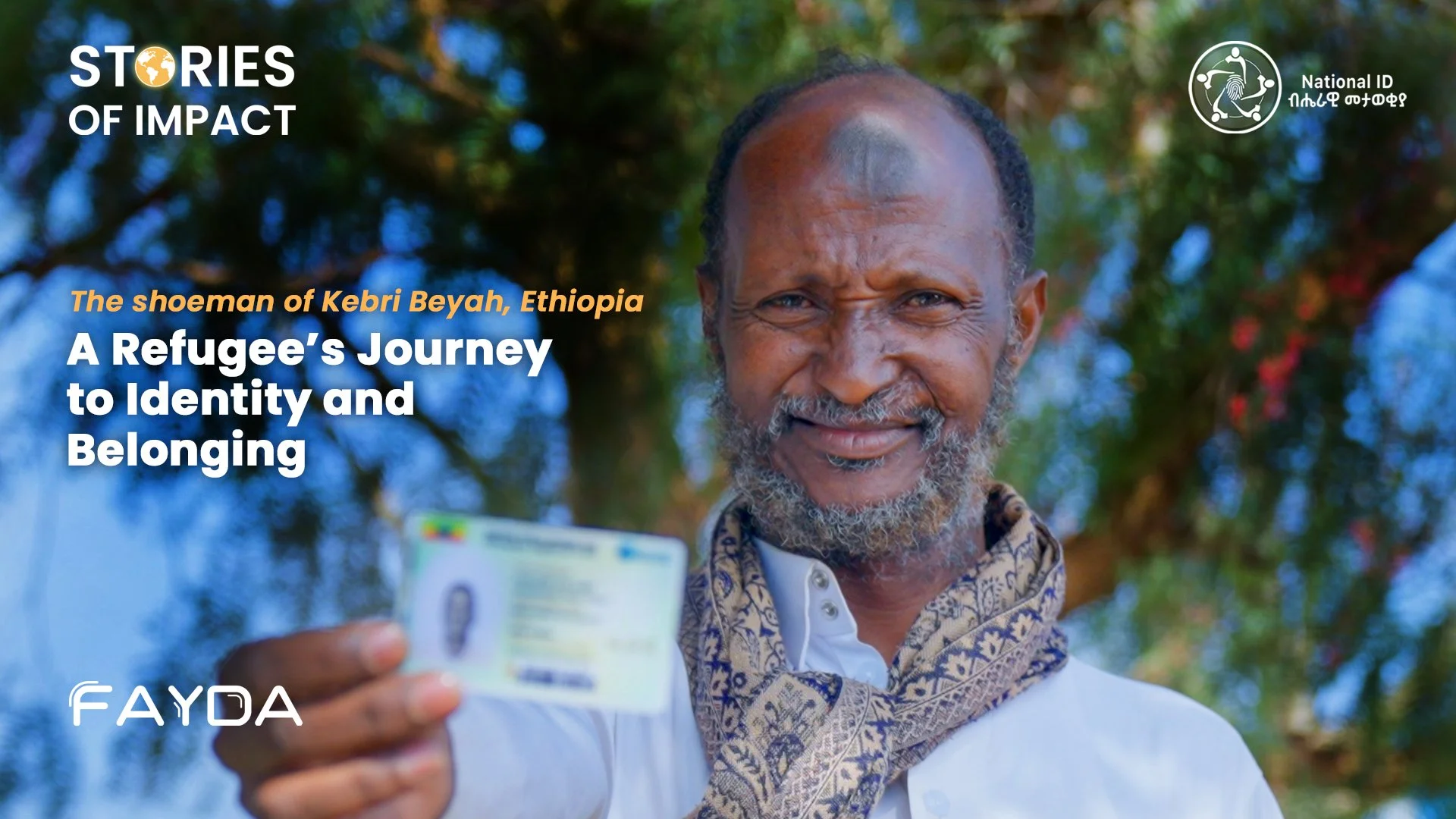
The shoeman of Kebri Beyah, Ethiopia:
A Refugee's Journey to Identity
Jemal Mohamed Elmi lives in Kebri Beyah Woreda in the Fafan Zone’s refugee camp area, near Jijiga—what the locals call ‘Jigjiga’—in Ethiopia’s Somali Region. Every morning, he opens his shoe shop close to his home. The shop is modest: flip-flops and slippers arranged in neat rows on simple shelves..
Children greet him with smiles as they pass by, some stop to admire the colourful shoes, some plot about convincing their parents to buy a pair.
This shoe shop represents something big to Jemal: independence, dignity, and a life rebuilt with resolve.
A refugee, an entrepreneur, a husband, and a father of seven, Jemal has lived in this corner of Kebri Beyah since 1992. Jemal fled from Mogadishu in the Siad Barre regime in southern Somalia during the height of the Civil War. He arrived in Ethiopia with nothing but the clothes on his back, nursing a gunshot wound in his leg.
“I didn’t come here by choice,” he says, “but I chose to stay, to try and make a living.”
A life rebuilt from scratch
Jemal was raised in southern Somalia, in a family of livestock traders. He grew up watching his father buy and sell cattle, and picked up the rhythms of small trade and negotiation.
But war shattered that life. Jemal was a student when he lost his father and two of his brothers to the conflict. He got separated from his mother and the rest of his family. He was shot in the knee while trying to escape. He crossed the border into Ethiopia with the help of his neighbours. He found work wherever he could near the refugee camp: clearing land, unloading goods. His wound took over a year to heal, after which he taught sports at a local kindergarten school.
Eventually, he began selling shoes and built a stall of his own on the roadside.
In the year 2000, he married his wife, an Ethiopian. She supported the family with petty jobs and chores around the camp. Together, they raised seven children, teaching them to work hard, stay kind, and never give up, even when money was tight.
The turning point: A digital identity and growth in business
Despite his perseverance, Jemal’s business was constrained. He couldn’t travel outside the refugee camp area to purchase supplies. To leave the camp, he had to go through a slow process of applying for a temporary permit, valid for only three days.. Moreover, he couldn’t officially register his business or access credit. The ID given to him by the Refugees and Returnees Service (RRS) helped him avail services such as food rations, healthcare, and schooling for his children but it couldn’t help him move beyond the camp, grow his business, or set up a bank account to secure loans.
“I wanted to grow my business and do better for my family, but I felt like my hands were tied.”
He heard about the Fayda ID through a community awareness campaign. At first, he wasn’t sure if he would be eligible as a refugee. But soon, through the campaigns, he learned that Fayda was designed to include everyone residing in Ethiopia, including refugees and asylum seekers, giving them access to essential services beyond those provided by the RRS.
With guidance from the National ID Program, RRS, and support from local officials, Jemal applied for the Fayda ID. The process was fast and respectful. Biometric scans, clear instructions, and no judgement.
“No one asked me why I wanted it, they just said: let’s get this done. They seemed more eager to help me than I was to get the ID”, he chuckles.
For Jemal, the Fayda ID accorded him dignity.
With the Fayda ID, Jemal could finally go past the security checkpoints outside the refugee area without any prior permits. He was able to travel to nearby cities like Jijiga, and even to Addis Ababa, to buy shoe stocks in bulk. For the first time, he could choose what to sell, and not just settle for what was available. His inventory grew, and so did his confidence.
The Fayda ID enabled him to register for a Tax Identification Number (TIN). With the TIN, he was able to get a SIM card in his own name. He no longer had to rely on borrowed mobile numbers. He could now receive payments through mobile money, which made business transactions easier. Customers came from farther away, and his business grew. The TIN also gave his business a legal status.
Jemal could now also use WhatsApp on his personal number, a small but powerful change that allowed him to try and reach out to the family he lost contact with during the war. He also recalls with pride, “I was able to get on an airplane for the first time thanks to the Fayda ID!” He was the first in his family ever to do so, and the memory still fills him with joy.
With steady income, Jemal kept investing in his shop and his family. He began with a single cabin-sized shop. Today, thanks to his profits, and access to credit because of the TIN, it has grown, doubling his space, his stock, and his sense of possibility. He has hired an assistant to share the workload at the shop.
Jemal has taken multiple business loans over the years, repaid them, and built a second home for his family, so his children could have space to read, study, and sleep at ease.
The original home—stitched together with tarpaulin and cloth, where the entire family once slept side by side—still stands next door, a quiet reminder of how far they’ve come. Today, Jemal’s teenage children have a space of their own in their new home.
A role model and a life of dignity
Neighbours come to Jemal seeking help, asking about the Fayda ID, about suppliers, about how to get started with a business.
He walks them through it patiently. “I tell them: don’t be afraid. If an old man like me is brave enough to trust and understand technology, what’s your excuse?”
Most of his family members now have Fayda IDs. His younger children will receive theirs once they are eligible. He encourages friends, fellow traders, and neighbours to enrol and enable access to all the benefits.
Jemal’s everyday routine remains the same, yet his life has profoundly changed. He no longer walks with hesitation, especially at checkpoints when he travels. His shop is bigger than it was before. He no longer depends on others to vouch for him. His business is officially registered and credit worthy. Above all, Jemal is identified by his name and not just as a refugee.
All Jemal wanted was some support to grow his business and care for his family. Instead, he feels he has been handed opportunities he never thought possible. “I think the ID has given me access to all the services an Ethiopian has access to”, he says as his face breaks into a smile.
He hopes his family grows to be confident, educated, and free to move, even beyond Ethiopia, if that’s what they choose. His dream is that they’ll build something of their own, with fewer obstacles and more choices, and that one day, they can search for his mother and family he lost in the war.
As of 2025, over 30 million individuals across Ethiopia have registered for the Fayda ID. That includes rural farmers, students, traders, and over hundred thousand refugees like Jemal, whose lives are now supported by systems that once didn’t recognise them.
About: The technology and digital public infrastructure
Fayda means “value” or “benefit” in Amharic, Ethiopia’s widely spoken language. Fayda is Ethiopia’s foundational digital ID that serves at the national level, built on the Modular Open Source Identity Platform (MOSIP), an open-source, modular digital public infrastructure (DPI). It combines demographic data with eye, facial, and fingerprint biometrics to provide a unique 12-digit Fayda ID number (FIN). The ID enables individuals to verify their identity digitally and enables eKYC (electronic Know Your Customer) for businesses such as banks.
Designed to be interoperable, reusable, and modular, Fayda serves as a unified platform to support a broad range of services from agriculture and banking to health and education, making it a key pillar of Ethiopia’s digital future.
The National ID Program, backed by Ethiopia’s Prime Minister’s Office, leads the implementation of Fayda, with support from a growing ecosystem of government partners, financial institutions, and local service providers like Digital Green and Awash Bank.
Co-Develop, a global non-profit fund supporting countries to build inclusive, safe, and equitable DPI, has developed this story in collaboration with knowledge partner Kalpa Impact.
The Fayda ID is available to a wide range of individuals, including non-Ethiopian residents, refugees, and asylum seekers. Jemal’s story is proof that when systems make room for everyone, extraordinary things can happen.
Other Insights